On Wednesday
we held our first TW:eed team meeting at the University of Leicester. 17 people
from the team met up for an afternoon of talks and discussions on the work we
have been doing in the last 5 months. We also discussed future plans for the
project such as drilling the borehole.
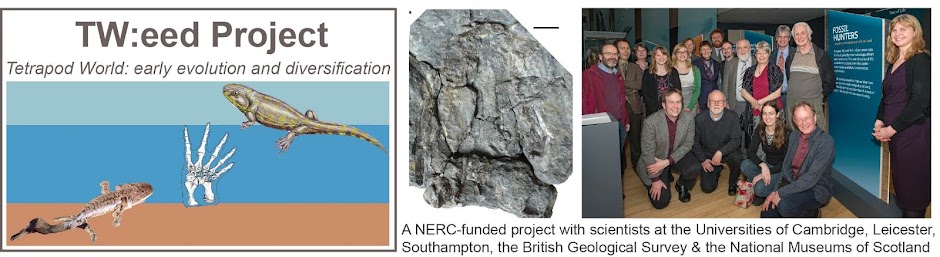
Some of the TW:eed team at the
meeting. From left to right: Melanie Leng, Tim Smithson, Tim Kearsey, David
Millward, Jenny Clack, Sarah Davies, Dave Carpenter, Jon Lakin, Janet Sherwin,
John Marshall, me, Ket Smithson, Rob Clack. Absent are the National Museum of
Scotland team of Nick Fraser, Andy Ross and Stig Walsh, who had to leave
promptly to catch a train.
Jenny Clack
told us about some of the fantastic new tetrapod and fish fossils that they
have found throughout sites in the Scottish Borders, Northumberland and the
Midland Valley of Scotland. It is wonderful to see that so early on in the
project so many specimens have been discovered already, and that they can tell
us so much about evolution in the early Carboniferous. Tim Smithson, Ket
Smithson and Rob Clack from the Cambridge team, along with Sarah Finney and
project partners have been busy identifying vertebrate material and piecing
together skeletons. Large arthropods have also been found as well as some
exceptional ray finned and lobed finned fish fossils, some of which Ket is
studying for her PhD project.
Dave Millward
and Tim Kearsey from the BGS updated us on progress with the borehole, which we
are planning to start drilling in April. This will be a 500 metre long borehole
to produce a rock section throughout the entire Ballagan Formation that we can
date and use to correlate the field discoveries. The preservation of fossils,
sedimentary structures and geochemical signatures should be much better in the
borehole compared to field sections that are open to the elements, so its
provides a great opportunity for further study in those areas.
The National
Museum of Scotland team (Nick Fraser, Andy Ross and Stig Walsh) are
co-ordinating fieldwork plans for the summer of 2013, including a significant
palaeontological excavation. Nick Fraser is also planning a symposium at the vertebrate
palaeontology conference SVPCA, in commemoration of Stan Wood. Look out for
more details of this in the coming months.
My rock display of cementstones and
sedimentary log through the Ballagan Formation. Each cementstone is a different
rock type or contains different fossils.
I displayed
some of the cementstones from the Ballagan Formation that I have been
processing, to discuss with the team their different mode of formation and the
environments that may have been present. I also laid out a graphic of the
sedimentary log I drew while in the field, to discuss the patterns present and
the link to fossil finds. Melanie Leng, Sarah Davies, Master’s student Janet
Sherwin and I updated the rest of the team on our plans for further
sedimentology, geochemical and micropalaeontological work from tetrapod-bearing
sites. This includes working on boreholes (more in the next post!) and field
sites. We also aim to increase the links between the blog and website, such as posting
upcoming meetings and talks on both.
Now it is
time to go back down the basement for more sawing, splitting and crushing rocks.
There is always something new, so I wonder what I will find today?
Until next
time
Carys
This comment has been removed by the author.
ReplyDeleteDear Carys,
ReplyDeleteI live in Ballagan House (or more precisely, in the Stables of Ballagan House. I often walk in Ballagan Glen (indeed own a small part of it). I have often wondered which parts of which strata would be worth looking at for fossils when I walk by.
Care to come by and show me next time you're in Scotland? If so email me at R.Insall[at]beatson.gla.ac.uk
See photo - http://www.flickr.com/photos/dictybloke/3314745442/
Best, Prof. Robert Insall